


A Laravel Reverb realtime client for Flutter. It speaks the Pusher wire protocol in pure Dart — no native plugins — with a Laravel Echo-style API: chainable, cancelable listeners, automatic reconnection with re-authorization, presence channels, and client events (whispers).
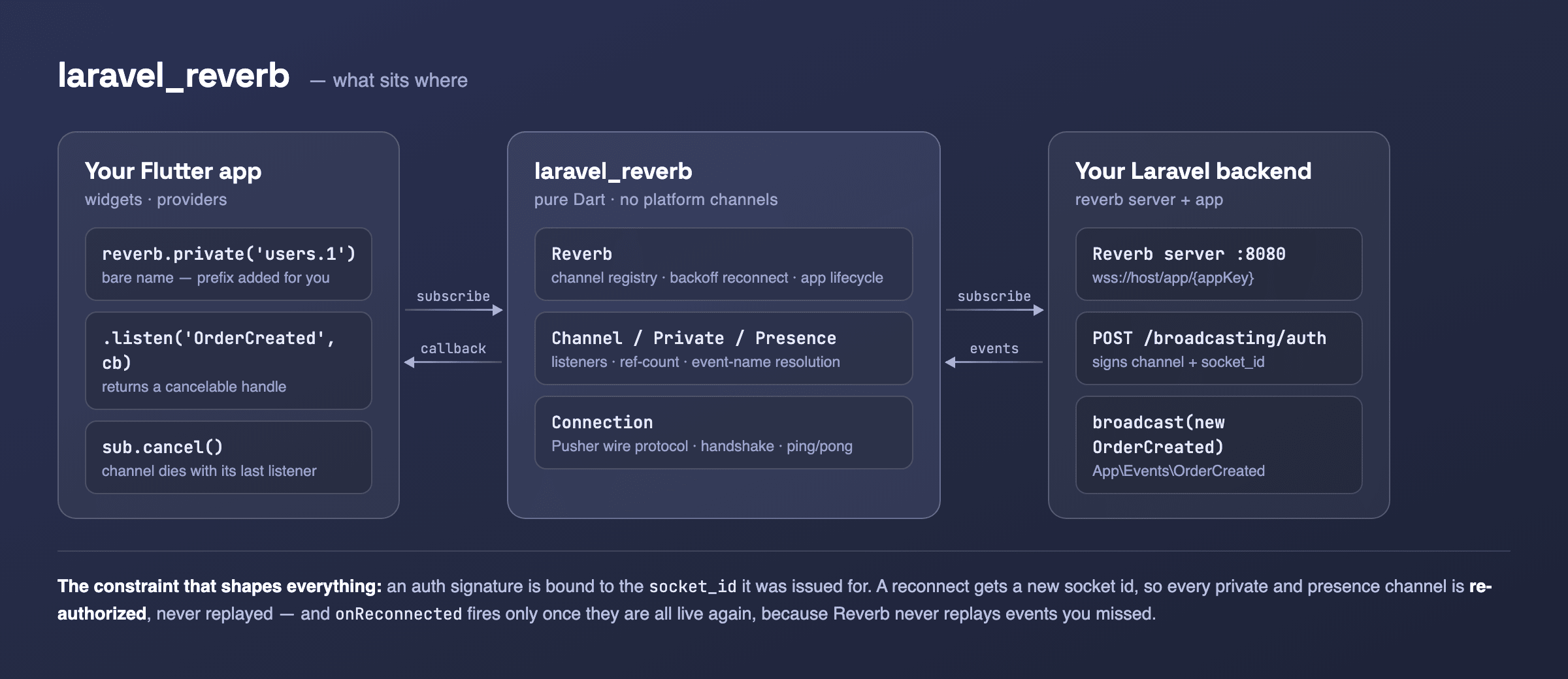
It exists because of three specific problems, each of which cost us a production bug in a shipped app:
- A channel outlives one screen. Two screens listening to the same channel
is normal, and a bare
unsubscribe()from either one tears it down for both. Here,listen()returns a handle and the channel only unsubscribes when its last listener is cancelled — so ref-counting is an invariant of the package, not aMap<String, int>every app maintains by hand. - Backgrounded apps hold dead sockets. iOS silently kills a socket the app
isn't watching, and the client never notices.
handleAppLifecycle(on by default) disconnects on background and reconnects on foreground. - Event names are Laravel's, not the wire's.
listen('OrderCreated')resolves toApp\Events\OrderCreated, andlisten('.order.created')to abroadcastAs()name — the same rules Laravel Echo uses, so your backend docs translate directly.
pusher_reverb_flutter is a
mature, actively maintained alternative that solves much of the same problem,
and it is the better choice if you need any of these — none of which this
package supports:
- Encrypted channels (
private-encrypted-) - Pusher's hosted service, clusters or API-key configuration — this package targets self-hosted Reverb only
- Custom WebSocket paths
Pick this one if ref-counted channel teardown, app lifecycle handling, or Echo-compatible event names are what you're missing. Both are MIT and speak the same protocol, so switching either direction is a mechanical change.
flutter pub add laravel_reverbThis package targets a self-hosted Reverb
server, not Pusher's hosted service. In your Laravel app's .env, set:
BROADCAST_CONNECTION=reverb
REVERB_APP_KEY=your-reverb-app-key
REVERB_HOST=api.example.com
REVERB_PORT=443
These map directly onto the Reverb constructor: REVERB_APP_KEY to
appKey, REVERB_HOST to host, REVERB_PORT to port.
final reverb = Reverb(
  host: 'api.example.com',
  port: 443,
  appKey: 'your-reverb-app-key',
  useTls: true,
  authEndpoint: 'https://api.example.com/broadcasting/auth',
  authHeaders: () async => {'Authorization': 'Bearer $token'},
);

await reverb.connect();onError(constructor parameter) is how the package reports runtime failures it handled without throwing — a dropped socket, a rejected subscription, a failed authorizer, a non-fatal protocol error. There is no other channel for these; if you don't pass it, they are reported nowhere.reverb.statesis aStream<ReverbState>of every connection state change (connecting,connected,reconnecting,disconnected,failed);reverb.stateis the current value.handleAppLifecycle(defaulttrue) disconnects on background and reconnects on foreground, so iOS doesn't hold a socket the OS will silently kill. Set it tofalseif your app manages the socket itself.- Call
reverb.dispose()from your app's teardown (e.g. alongside other singletons at shutdown). It disconnects, stops observing app lifecycle events, closes thestatesandchannelHealthstreams, and closes thehttp.Clientit created forauthEndpoint(if any) — skipping it leaks the socket, the lifecycle observer and that client's connection pool. A client you passed in yourself via a customauthorizeris never touched — that one is yours. reverb.disconnect()closes the socket and stops reconnecting, keeping channels and listeners so a laterconnect()restores them — this is what the app-lifecycle pause/resume path uses. Passdisconnect(forget: true)on logout instead: it also drops every channel, clears registeredonReconnectedcallbacks, and makes every handle created before the call permanently inert, so a screen still holding the previous user's channel can't resubscribe it — or whisper on it — under the next user's session.
final subscription = reverb.channel('orders').listen(
  'OrderCreated',
  (Map<String, dynamic> data) => print(data),
);listen returns a chainable Subscription; cancel it in dispose to remove
every listener registered through the chain.
class _OrderScreenState extends State<OrderScreen> {
  Subscription? _subscription;

  @override
  void initState() {
    super.initState();
    _subscription = reverb
        .private('users.1')
        .listen('OrderShipped', (data) => print(data))
        .listen('OrderCancelled', (data) => print(data));
  }

  @override
  void dispose() {
    _subscription?.cancel();
    super.dispose();
  }
}
A channel unsubscribes once its last listener is cancelled, but the handle
itself is never left dead: calling listen on it again resends
pusher:subscribe (re-authorizing private and presence channels against the
current socket id) and puts it straight back to work — as long as nothing
else has since claimed the same name. Stick to one pattern per channel name:
either keep reusing the handle you already have, or always ask reverb for
a fresh one (reverb.private('users.1'), etc.). Mixing the two for the same
name — holding an old, emptied handle while also asking for a new one — means
only the one holding the name is live. The other stays inert, and it does not
wake up on its own when the occupant releases the name: it only reclaims it on
its own next 0-to-1 listener transition.
final channel = reverb.presence('chat.1');
channel.members(
  here: (members) => print('online: $members'),
  joining: (member) => print('joined: ${member.id}'),
  leaving: (member) => print('left: ${member.id}'),
);
members also takes a roster callback, which receives the full member set
on subscribe and after every join or leave — reach for it instead of
here/joining/leaving when you want a live set rather than deltas:
channel.members(roster: (members) => updateSeatMap(members.values));channel.currentMembers exposes the same set synchronously, for whenever you
need it outside a callback. Membership does not survive a socket drop: it is
cleared when the connection is lost and re-seeded from the server once the
channel resubscribes.
Whispers are only available on private and presence channels — they never reach the application server, so they suit ephemeral signals like typing indicators.
final channel = reverb.private('chat.1');
channel.listenForWhisper('typing', (data) => print('${data['user']} is typing'));
channel.whisper('typing', {'user': 'Alice'});A bare event name is namespaced against App\Events (or whatever namespace
you passed to the constructor), so listen('OrderCreated') matches the wire
event App\Events\OrderCreated. A leading dot means a literal
broadcastAs() name: listen('.order.created') matches an event broadcast as
order.created.
When the socket drops, laravel_reverb retries with exponential backoff —
1s, 2s, 4s, 8s, 16s, capped at 30s, with jitter so that clients dropped by the
same outage don't all reconnect in lockstep. On reconnect, every private and
presence channel is re-authorized against the new socket id, because a Pusher
auth signature is bound to the socket id it was issued for.
Reverb does not replay events missed while disconnected — this is exactly
what onReconnected is for. It fires only after every previously-live
channel has resubscribed (so a refetch can't race a half-restored socket),
and it does not fire on the first successful connect — but an explicit
disconnect() followed by connect() does fire it, since that is a real
restore too. The exception is disconnect(forget: true): it clears every
registered onReconnected callback, so the following connect() has none
left to run:
reverb.onReconnected(() => refetch());If an Authorizer throws for a given private or presence channel, that
failure is reported through onError and laravel_reverb retries it with
the same exponential backoff used for reconnects, up to three attempts in
total. Every failure — including the last — is reported through onError,
so a transient 500 or a token that is momentarily expired is never silent.
Once the last attempt fails, the channel is left registered but subscribed to nothing — re-listening on the same handle, or requesting it again, does not retry on its own, since from the registry's point of view the channel is still there and already has its listener. Cancel every listener on it first, so it actually unsubscribes and is dropped from the registry, and then listen again (or request it again) to force a fresh authorization attempt:
subscription.cancel();
final channel = reverb.private('users.1'); // retries authorizationBy default, laravel_reverb pings only after the server's advertised
activity_timeout of silence, and treats a missed pong as a dead socket —
this is exactly 0.2.0's behaviour, and it can take close to a minute to
notice a half-open connection. For an app that needs to notice much faster —
a realtime game, a live dashboard — set pingInterval and watchdogTimeout:
final reverb = Reverb(
  host: 'api.example.com',
  appKey: 'your-reverb-app-key',
  pingInterval: Duration(seconds: 10),
  watchdogTimeout: Duration(seconds: 15),
);
Once the handshake lands, death detection is always on, in every configuration:
- Neither set (the default): the legacy idle-ping, backed by a pong deadline.
pingIntervalalone: a periodic ping on that schedule, still backed by a pong deadline.- Both set: a periodic ping plus an inbound-frame watchdog. The watchdog resets on any frame from the server, but deliberately not on our own outbound sends — a socket that can still write but never receives is exactly the failure it exists to catch.
watchdogTimeout must be longer than pingInterval, or the constructor
throws ArgumentError — a shorter watchdog would fire between pings and the
client would reconnect forever.
None of these cover the window before the handshake: a socket whose upgrade
succeeds but which never sends pusher:connection_established is not yet
watched, and connect() waits on it. Set a connect timeout at your HTTP or
platform layer if that matters to you.
reverb.channelHealth is a Stream<ChannelHealth> of per-channel up/down
transitions, deliberately separate from reverb.states: a connected socket
whose channel authorization was rejected is ReverbState.connected and
unhealthy here, which is what degraded-mode polling should gate on rather
than the socket state alone.
reverb.channelHealth.listen((health) {
  if (!health.healthy) startPollingFallbackFor(health.channel);
});
health.channel is the wire name, including any private-/presence-
prefix. reverb.isSubscribed(wireName) reports the current value for one
channel without subscribing to the stream.
For apps that need their own HTTP client, interceptors, token refresh or
certificate pinning, pass authorizer instead of authEndpoint. The package
then makes no HTTP requests of its own:
final reverb = Reverb(
  host: 'api.example.com',
  appKey: 'your-reverb-app-key',
  authorizer: (String channelName, String socketId) async {
    final response = await myHttpClient.post(
      Uri.parse('https://api.example.com/broadcasting/auth'),
      body: {'socket_id': socketId, 'channel_name': channelName},
    );
    return ReverbAuth(auth: jsonDecode(response.body)['auth'] as String);
  },
);| pusher_channels_flutter | laravel_reverb |
|---|---|
init(...) + connect() |
Reverb(...) constructor + connect() |
subscribe(channelName: 'private-users.1') |
private('users.1') — the prefix is added for you |
onAuthorizer |
authEndpoint/authHeaders, or authorizer for a full override |
Manual ref-counting / unsubscribe |
Subscription.cancel() — the channel tears itself down once its last listener is gone |
trigger(eventName, channelName, data) |
channel.whisper(eventName, data) |
Published under the pub.dev verified publisher gaitco.com.